I started playing billiards (pool) in summer of 2019 and it was love at first sight (or play :)) Spent hours playing in league and many more hours playing in my head; watched a lot of videos. Most of what I did was learn how to make balls. One thing I noticed was, during practice I used to shoot great, but when it came to competitions I used to struggle; could feel heart rate peaking, hand shaking and missing shots I could make without thinking during practice.
Took a friend pointing it out to me that I need to not just practice on "making balls" but also getting into a "right mindset".
After a particularly bad form in a higher competition, and feeling low and bad about it, my wife asked me
- Her: Why do you like to play pool?
- Me: I love to make balls; when a shot in my head comes off well on the table - that feeling is so good, do not know how to even describe it
- Her: Why do you care if you win or lose?
- Me: aaaaaaaaaaaa, I do not (Mind = Blown)
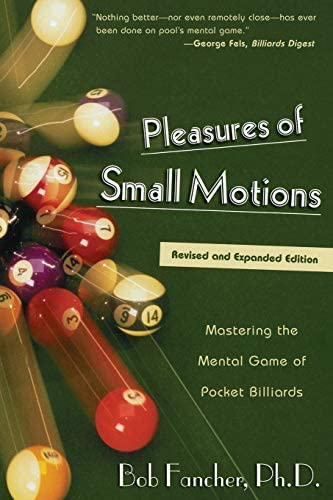
This is also around the time when I found "Pleasures of Small Motion" and changed the way I think.
Pleasure of Small Motions by Robert Fancher has helped me compete better and get in good mindset before any type of game friendly (or) competitive.
Why You Play Matters
The first question the book asks is a simple one. Do you play to win — or do you play because you love the mechanics of making a ball?
That distinction matters more than it sounds. If winning is the whole point, then missing a shot or losing a match threatens the entire reason you showed up. But if you are there for the feel of a well-executed shot, that is always available to you, regardless of the score.
Fancher also makes a broader point: people need multiple competencies to sustain themselves. When the one thing that gives you pride and satisfaction is unavailable — a bad run, an off night, a tough opponent — you need somewhere else to draw from. Pool players who are only invested in outcomes have nothing to fall back on when outcomes go sideways.
The Mental Game
The best self-talk during play is none
Research across multiple sports shows that when the best competitors are playing well, the conceptual and verbal centers of their brain show very little activity. The sensory center, on the other hand, works vigorously. You are not thinking about the shot in words. You are feeling it.
To build that, you need acute body awareness. Every time you shoot, pay attention to what you actually did — and what happened as a result. Correlate the two. Commit the image to memory. Over time, that builds an internal library you can draw on without consciously reaching for it.
Deliberate practice builds new wiring
Careful, deliberate practice physically changes the brain. Until that new wiring develops, you have to control actions consciously — paying deliberate attention to a shot, checking your stance, tracking your follow-through. That is not a sign of weakness. That is how the wiring gets built.
Once it is there, those things become automatic. Conscious brain circuits are freed up to consider more advanced and subtle possibilities at the table. The repetition is not tedious — it is the mechanism.
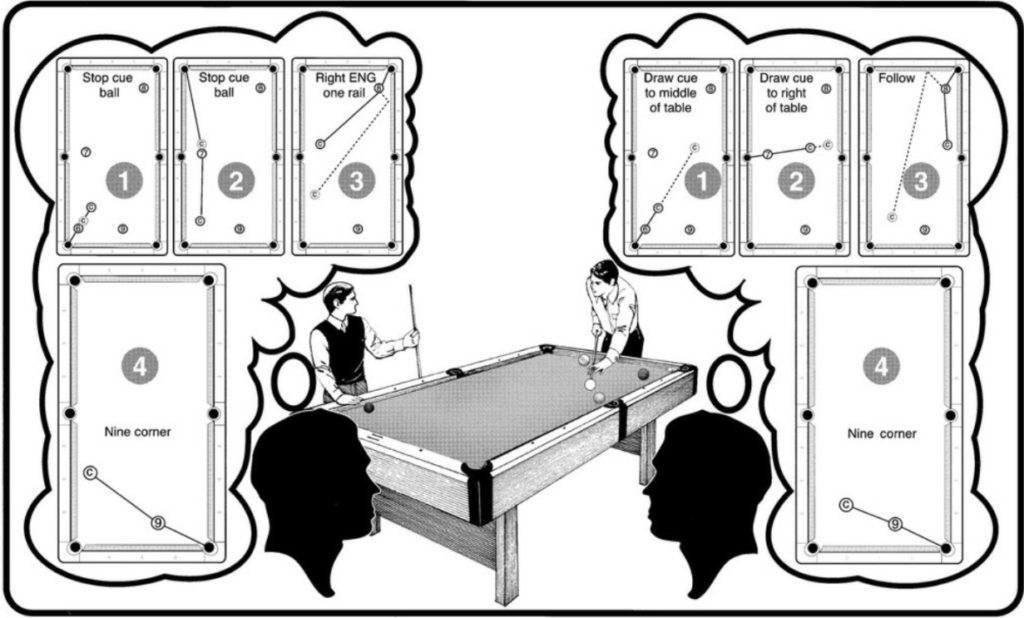
Patterns are not on the table. They are in your mind. What you see when you look at a rack depends entirely on what you know. A player who cannot draw a ball sees one set of options. A player who can sees a completely different table.
Concentration
Concentration is simply centered, well-ordered thinking. To concentrate is to establish a center — around which everything else is systematically arranged.
In pool, the center is always your body. The object ball moves because the cue ball moved. The cue ball moved because the stick moved. The stick moved because your body moved. That chain starts with you, and that is the only part of it you can control. Concentration starts there and stays there.
Fancher describes a feed-forward process that sits at the core of any well-executed shot:
- A mental representation — a dynamic image of what is going to happen
- Attention to what is actually happening as you take the shot
- Comparison of the action to the image
- Correction, where needed, to bring the action in line with the image
Concentration is constructing a complete image of the shot, centering on your body, then understanding and guiding your bodily motions by reference to that image.
Emotions and Performance
Emotion is simply the motivation to act in a specific way, under specific circumstances, to pursue something we care about. It is not the enemy of good play. The right amount of it is actually necessary.
Increased emotional arousal improves concentration and motor control — up to a point. Past that point, it causes excessive narrowing of focus and disrupts the automatic processes you have spent hours building. Too little emotion and you do not care enough to fully focus. Too much and your attention collapses to a tunnel.
The mistake most players make on a bad night is to double down on conscious control — thinking harder about each shot, monitoring everything. That is exactly wrong. It crowds out the sensory awareness that good play depends on.
One more thing worth knowing: your emotions have already started before you are consciously aware of them. Preconscious perception triggers an appraisal process that sets emotion in motion before your conscious mind catches up. By the time you notice you are anxious or frustrated, it has been running for a moment already. That is why ignoring it does not work — it is already shaping your motor control and attention whether you acknowledge it or not.
Modulating emotions well involves three things working together:
- Attention to your goals — what are you actually trying to do right now
- Appraising the significance of the specific circumstances — is this shot as critical as it feels
- Assessing the probability of outcome — honestly, given your ability, what is likely to happen
Do not ignore negative thoughts — deal with them
When a negative thought surfaces mid-match, the instinct is to push it away. That does not work. The concern that generated the thought is still there, shaping your motor control and mental attentiveness whether you acknowledge it or not.
The better move is rational internal dialogue. Down 6-to-2 in a race to 11, you might think: "I'm in trouble — he only needs 5 more." The correct response is something like: "That's true. He won six of eight. I can win six of the next eight. I need to settle down and stay centered on my body."
You use two things to do this: body awareness — checking whether you are walking too fast, gripping too tight, not stroking enough — and rational internal conversation to establish what, realistically, you need to do next.
Confidence is a prediction, not a feeling
Confidence always comes from a prediction you make about the probability of success. Predictions grounded in accurate self-knowledge and reasonable expectations generate rational confidence. Predictions based on wishful thinking collapse the moment reality pushes back.
The easiest way to destroy confidence is to expect something highly unlikely, fail to achieve it, and then make excuses. If you typically run out five balls in the open 20 percent of the time, and you make four of five — you played well. That is on your game. The standard has to be calibrated to your actual ability, not your ideal one.
Competing Well
Competitive skills are different from shooting skills. You can be technically excellent and fall apart in a match. The two need to be developed separately.
Competition is a social process — you are being assessed, and you know it. The effect on your play is always relative: relative to the standards you expect to be judged by, and to your estimation of whether you can meet them. Understanding that takes some pressure off. Everyone in the room is navigating the same dynamic.
A useful mental baseline to start any competitive match with: I want to see if I can play better than before, with no fixed idea of the outcome, but a genuine desire to win.
Pay attention to your opponent — their strengths, their tendencies, their patterns — and make your game plan accordingly. Then pay equal attention to your own game that day. Some days your draw is working. Some days it is not. Select your shots to match the version of yourself that showed up, not the one you wish had.
When you compete, winning is the overriding goal — not the only one. The pleasure of the strokes, the rhythm of the game, the challenge of the match — those do not disappear. They take on a specific shape in service of winning. That is very different from making winning the only thing that matters.
The Pleasures of Small Motions
The fundamental reason most people play pool — when they are honest about it — is the delight in precise control of small motions. The satisfaction of a fine motor action causing a predictable, intricate, elegant outcome. That feeling is always available to you, on any shot, in any match, at any score.
We lose sight of it. Subsidiary concerns creep in and take center stage. The score. The audience. The shot we just missed. And when that happens, the thing that made the game worth playing in the first place quietly steps aside.
Keeping the pleasures of small motions central is not just a philosophical stance. It is a practical tool for staying emotionally calibrated at the table. Because no matter what the circumstances, there is always a shot available to you that can fulfill that interest.
The game captivated you for a reason. Do not let the score make you forget what it was.